


This post is sponsored by KODIAK – Proven Workforce Solutions. I wouldn’t accept a sponsor for this newsletter unless they were 1) a company I trust and 2) addressing critical issues like skilled labor shortages in construction. KODIAK, which recently merged with Pivot, checks both those boxes. Their mission is to help construction companies find experienced talent, including engineers and project managers for Direct Hire, as well as skilled craft professionals like welders and electricians for contingent staffing. With over three decades of experience, I encourage contractors struggling to find workers to consider KODIAK.

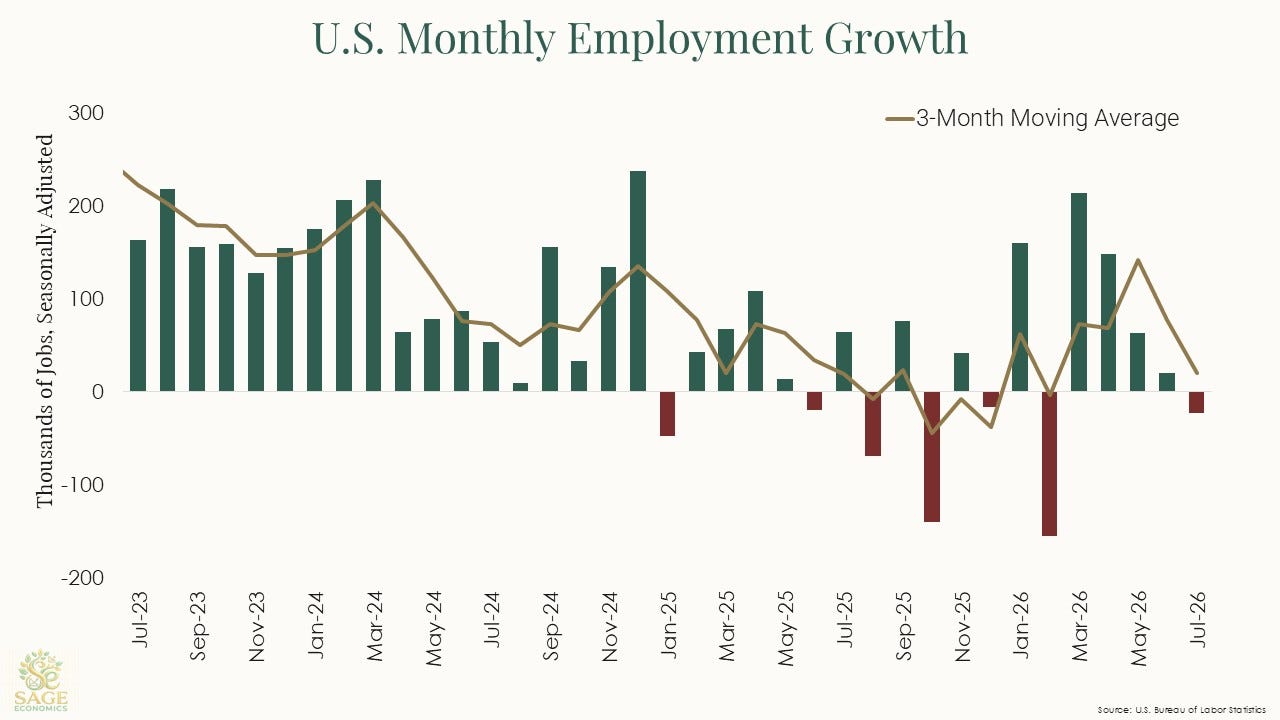
U.S. employment dropped by 23,000 in July. That decline, the first since February, fell comically short of the consensus expectation of about 80,000 new jobs (“comically” only in a dark, maybe-we-shouldn’t-laugh way). Even worse, downward revisions knocked about 100,000 jobs off the prior two months of growth.
You’re probably thinking this sounds bad. And it is. Losing jobs is never a good thing.
For context, employers added jobs in 113 straight months from late-2010 to the start of the pandemic. We’ve now lost jobs in 6 of the past 14 months. Three-month average job growth has slowed to an anemic 20,000.
But (unlike most cases, what came before the “but” actually does matter here), there are a few reasons that today’s report is ever-so-slightly less bad than it looks at a glance.
One: the unemployment rate fell to 4.1% in July, the lowest level in over a year. Part of the drop was due to a slight decline in labor force participation. Still, layoffs remain exceedingly low. There’s no reason to worry about unemployment at the moment.
Two: local government education employment fell by almost 50,000 jobs in July, and that’s likely a seasonal adjustment quirk. An upward revision is possible, even probable, next month.
Three: wage growth was weak. Average hourly earnings rose just $0.02 for the month and are now up a mere 3.2% year over year. That’s that smallest annual increase since 2018.
Three and a half: yes, this has bad implications for workers, but it’s good news on the inflation front.
Four: the prime age (25-54) employment-to-population ratio—a very important indicator—ticked back up in July after falling sharply in June.
Five: cyclical industries, like manufacturing and construction, added jobs for the month.
Six: a softening labor market is potentially good news on the borrowing cost front because it stops the Fed from raising rates. 10-year treasury yields fell this morning.
The Big Picture
If you really squint, you could maybe justify calling today’s report “mediocre.” Even that’s overselling it, in my opinion.
The labor market is weaker than we thought. Layoffs aren’t a problem, but job growth is. Even if this is a good sign for borrowing costs, it’s a bad sign for economic health.
What’s Next
This week was packed with data releases, and we’ll cover all of them in Week in Review, our every-Friday post that gives you everything you need to know about the economy in a breezy, five-minute read.
That will be out later today and is just for paying subscribers. If that’s not you and you want it to be, just click the subscribe button.