


It’s never a good sign for the economy when you have to learn about a new maritime chokepoint in the Middle East, and—bad news—the Bab Al-Mandeb, a strait between Yemen and the Arabian Peninsula, features heavily in this week’s Review
In addition to new waterway knowledge, this week brought us $100/barrel oil prices, surging treasury yields, a flurry of new tariff activity, and more.
Monday
White House Announces Canada Tariffs
The White House vowed to impose tariffs as high as 50% on goods “ranging from wine to hockey sticks to cement.” Energy, potash, certain products tariffed under Section 232 (think metals), and critical minerals will be exempt from these new tariffs.
Just as interesting as the tariffs themselves is the mechanism used to impose them: Section 338 of the 1930 Tariff Act, a provision that’s never been used and could be defunct because it was superseded by a more recent law.
These tariffs don’t go into effect for 30 days. It will surprise no one if they don’t materialize. If they do, expect legal challenges.
The bigger takeaway here is that tariff activity is picking back up (see below and then again under Thursday).
White House Slashes Aluminum Tariffs
The White House reduced aluminum tariffs from 50% to 25% for companies committed to investing in U.S. production capacity. The defense industry pushed for this move, and the White House itself acknowledges that “US demand for primary aluminum currently outpaces the primary aluminum production capacity of US smelting facilities.”
Notably, prices received by U.S. aluminum producers are up 58% since the start of 2025 (the first aluminum tariffs went into effect in Feb-25). For context, that’s more than they increased over the whole 20 years before that (46%).
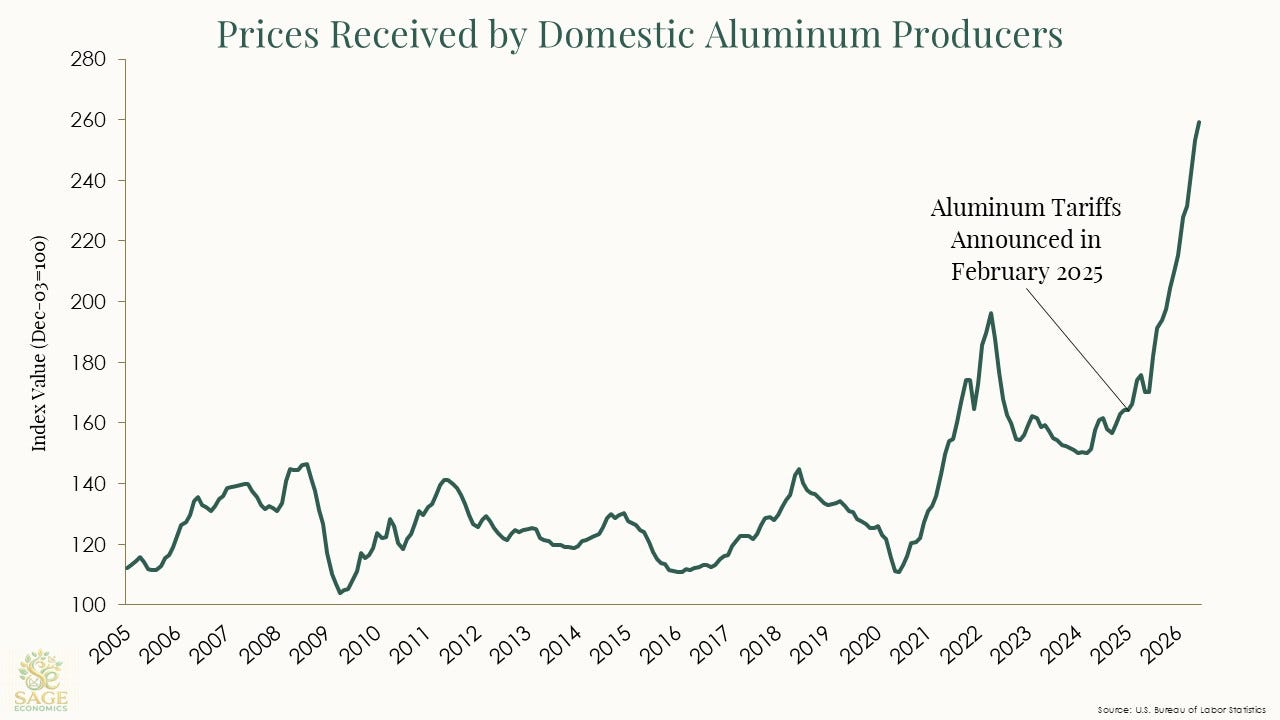
This follows an early-June reduction in tariffs on certain metal products.
TSA Checkpoint Travel Numbers
The summer travel season continues to disappoint, according to TSA gate check numbers. About 3.0% fewer people flew over the past week compared to one year ago.
A Cyclospora Update
Last week, we told you that the explosive-diarrhea-causing cyclospora outbreak had been linked to Taco Bell’s lettuce supplier, Taylor Farms. The FDA has since announced that it was a false positive that linked the outbreak to them but maintains that there’s “overwhelming epidemiological data” suggesting Taylor Farm’s lettuce is at fault.
North Carolina has since identified parsley and cilantro as potential sources.
Cyclospora is, apparently, very difficult to trace. If you’re interested in some of the nitty gritty details on that, Scott Gottlieb has a good and brief rundown here.
Stay safe out there, people!
Tuesday
State Employment & Unemployment Rates
South Dakota had the lowest unemployment rate of any state in June at a truly absurd and frankly unhealthy 2.0%. You’d think frictional unemployment, the period of joblessness when a worker is between jobs, alone would boost it above that level but hey, maybe South Dakotans are happy with the jobs they have.
No surprise: the highest unemployment rate belonged to D.C. at 6.0% as DOGE funding and federal employment cuts take their toll. Despite the nation’s highest rate of joblessness, unemployment in the District has actually fallen 0.2 percentage points over the past year.
Wednesday
The Congressional Trade Powers Reform Act of 2026 (Good tariff news?)
