


Policy Gripes is a series of posts where we combine our two highest forms of expertise: economic policy and complaining.
I say this as a proponent of low taxes and limited government: the “no tax on ____” movements need to end.
Over the past few years, we’ve seen least semi-serious efforts to end taxes on:
Tips
Overtime
Social security income
Bonuses
Property
Property, but just for seniors
Property, but just for anyone with a paid off mortgage (wtf?)
Sales tax, but only for diners in New Jersey that have been open for at least 25 years
Pet food
Car loan interest
Boat loan interest
Federal income tax for the entire middle class
Federal law enforcement income
Guns and ammo
I’m one “no tax on ____” proposal away from an aneurysm.1
It’s like the world’s worst game of Musical Chairs. When the music stops, the one W-2 worker who hasn’t gotten an exception will be funding the entire government.
The best taxes have low rates and broad bases, a design that leads to fewer behavioral distortions and steadier revenues. Granting exceptions to favored voters or industries necessitates higher rates on a narrower base. That leads to less predictable revenues.
At a political-level, I get it. This stuff resonates with voters. Take this quote from a New York Times’ focus group:
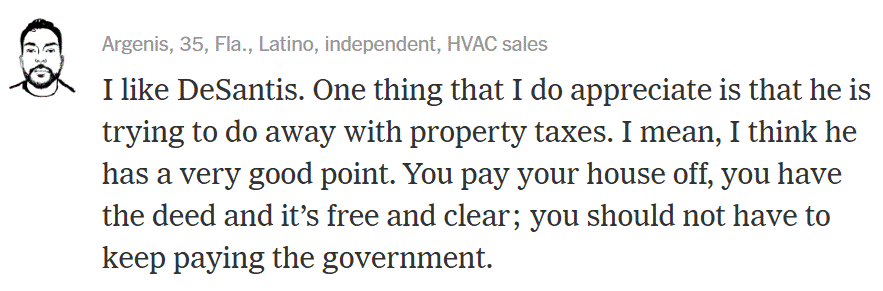
Except no, Governor DeSantis doesn’t have a very good point . What does a mortgage have to do with property taxes? Should sales taxes only apply to people paying with credit?
[You can read the Tax Foundation’s detailed analysis on Florida’s property tax proposal here.]
Yes, voters eat this stuff up, but we Americans notoriously eat all kinds of stuff that we really shouldn’t.
Briefly, here are a few reasons to oppose these efforts.
Thinking Through Incentives
High tax rates can reduce an unwanted behaviors like smoking cigarettes, drinking, gambling, etc.
Tax deductions, credits, and exceptions can encourage desirable behaviors like charitable giving, having children, etc.
Look at the list up above. Do we really want to incentivize tips and bonuses while disincentivizing salaries? Is stimulating boat buying a worthwhile policy goal? Even pets, much as I love them, do not need tax incentives.
Fairness
I don’t like fairness as a policy consideration, but come on. This is bad.
Take a teacher who makes $50,000/year (all salary) and a bartender who makes $50,000 (half tips). Under the OBBBA’s new “no tax on tips” provision, the teacher would owe about $4,000 in federal income tax, while the bartender would owe about $500.
Property Taxes Are the Worst Taxes (Besides All the Others)
Property taxes should be kept low. Property taxes are also critically important because they encourage the transfer of land to higher efficiency uses and produce revenues that are exceptionally stable over time.
Without carrying costs on real estate, you’d get major land hoarding, which would make housing less affordable in the long run and, quite possibly, in the short run too.
There’s also this notion that seniors shouldn’t have to pay property taxes (many states currently limit property taxes for seniors). I sympathize with anyone forced out of their home because of rising property taxes, but “the asset I own appreciated too quickly” isn’t the worst kind of problem.
These exemptions are hard on younger households, especially families (or would-be families) looking to become homeowners. Municipalities are forced to raise other tax rates to compensate for the lower revenues, shifting an even larger portion of the tax burden onto everyone else. This also reduces school funding while making it harder for those young families to afford a home.
California, which limits the annual increase in assessed value to 2% per year, is the poster child for how these policies can distort the real estate market.
The Government Needs to Be Funded
The federal deficit is $39 trillion. Will getting rid of these bad tax exemptions fix it? Not even a little bit, but given that neither party has the political appetite to cut spending, avoiding needless tax carve outs is a small and easy step in the right direction.
What’s Next?
We’ll have a Construction Trend Tuesday post out later this week. After that, it’s Week in Review, which is just for paying subscribers. If that’s not you and you want it to be, just click the button below:
Don’t misunderstand me, there are good tax exemptions out there. Take, for instance, the fact that virtually every state exempts manufacturing equipment from sales tax. That’s a well designed policy that incentives a desired form of investment.
I think this whole argument is flawed and offers no applicable comparisons. Furthermore, the examples from the "TIPS" argument between the schoolteacher and the bartender are completely flawed because they compare very different industries and work settings. It might as well compare the investment banker to the bricklayer... ridiculous. The sales tax example is also flawed and ridiculous... it is nowhere near applicable to the primary residence property tax issue. So I think this is a case of personality disagreement rather than policy. That said, no policy is perfect, but this is a broad policy that will benefit both the schoolteacher, bartender, and bricklayer, and the investment banker, all of whom own their primary residence and should not continue to pay taxes on it in perpetuity. As for the general tax concept, yes, I agree the best tax is the lowest possible that allows full funding of essential government services and should apply to the broadest base possible. But again, that is a separate issue.