


Construction Trend Tuesday covers one (hopefully) interesting industry trend in a quick, two-minute read. You can access the archive of CTT posts here.
Highway and street construction spending surged after the bipartisan Infrastructure Investment and Jobs Act was passed in November 2021. At a glance, this was an extremely successful bill.
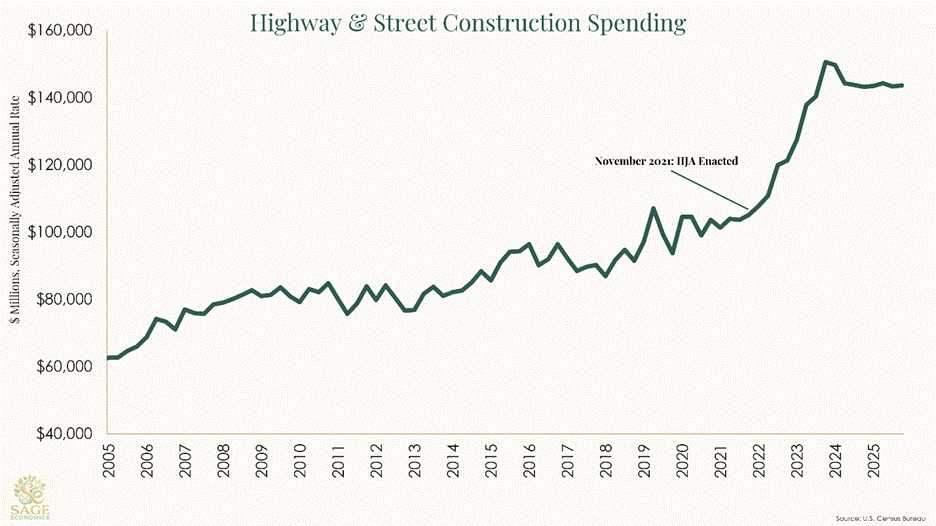
If you’re wondering why we felt compelled to say, “at a glance,” the above graph shows nominal (not inflation-adjusted) highway and street construction spending. The DoT’s National Highway Construction Cost Index let’s us take a deeper look, and the picture isn’t pretty.
Adjusted for the cost of building new highways, which is up about 73% since the IIJA was enacted, spending in the category is actually down 7.5%.
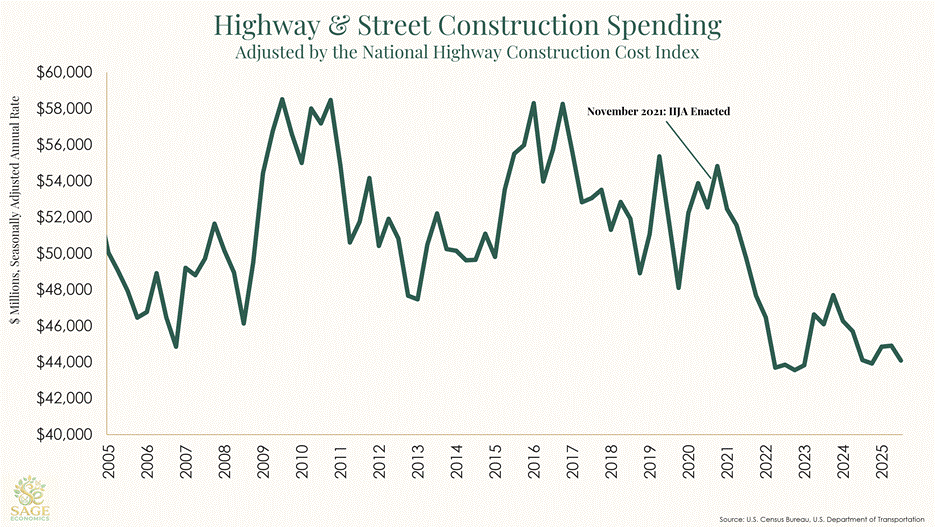
The NHCCI reflects winning bid prices, so it’s an all-in cost measure. What made it rise so rapidly since the end of 2021?
It’s tempting to blame labor scarcity and costs. Average hourly earnings for nonmanagerial highway and street construction workers are up about 32% over the past five years. That’s a lot, though not enough to fully explain a 73% overall increase in costs.
It’s also tempting to cite project labor agreements, but the vast majority of highway and street construction activity is, at least technically, funded at the state level (call it federally assisted, not federally funded). Of course, PLAs are used on these projects in certain union-friendly states and that raises prices via higher labor costs and fewer bidders.
Asphalt prices, up more than 40% since IIJA was enacted, have certainly played a part, as have other input prices, most of which are up significantly since 2021.
Rampant input and labor cost escalation also meant contractors had to build in larger contingencies and price for greater risk.
The biggest explanatory factor, however, is good ol’ supply and demand. IIJA passed at a time when the demand for construction services was greater than what contractors could supply. Housing was booming, as was the warehouse and manufacturing categories. Rates were low, and even segments that weren’t quite booming were snapping back to life.
Less contractor capacity during the first few years of IIJA led to fewer bids. Fewer bids led to higher prices.
The upshot is that taxpayers are getting less roadway per buck than it looked like we might when the IIJA was initially enacted.
What’s Next
This week brings us a ton of jobs data, two months of construction spending data, and a few different housing market indicators. We’ll cover that and a lot more in Week in Review, our every-Friday post that covers all the economic news and data in a breezy, five-minute read.
Week in Review is only for paying subscribers. If that’s not you and you want it to be, just click the subscribe button.
You identified a few of the elements that contributed to higher construction costs, but missed the big one: oil prices. Gas prices were sub-$2 in Jan. 2021 but increased >100% to $4+ by 2022. This was the driver behind the asphalt price you identified. Transportation costs for every single material, person and piece of equipment reaching every job site increased accordingly.