


We have over 3,000 words of Q&A for you. You sent in way more questions than we could answer. If we didn’t get to yours, sorry and send it in again next time!
Zack’s Answers
How many rate cuts, if any, do you suspect will happen in 2026?
Two? I don’t know. Nobody knows. The conflict in Iran, which has upended my already tenuous forecast, could last four weeks, four months, or for God only knows how long. At this point, I’d feel more confident guessing how many M&Ms are in a giant jar at an office party.
Has the elimination of de minimis harmed small businesses? For larger companies, has it had a significant impact, or is it just more of a nuisance?
This is a tricky question. The biggest victim of the de minimis exemption was foreign small businesses who had large customer bases in the U.S. (like this Australian jewelry seller).
For U.S. small businesses, it’s more of a headache. Sourcing is more complicated, with longer delays and more logistical work, and small businesses are unlikely to have a dedicated customs broker. They certainly don’t have a sourcing department that can give tariffs the attention it requires. As a result, some owners are probably now buying inputs in bulk (and then figuring out how to fund/store those larger orders).
[I run a small business and, as much as I enjoy the doing our actual work, I hate—HATE—any task that brings me in contact with big-business or government bureaucracy. Seriously. I’d rather shove a glass tube up my nose and then get punched in the face by Mike Tyson than have to figure out how to pay tariffs on $500 of foreign inputs. I’m angry just thinking about it. It’s fortunate that we’re a services firm.]
Of course, a domestic jewelry seller that no longer has to compete with that Australian shop is better off. Which is to say, some U.S. small businesses are benefiting from the end of the exemption.
Some large companies are likely benefiting because of how this harms small businesses, although I’m sure it was a headache for shipping firms like FedEx and UPS.
What can we expect in terms of political uncertainty during the coming months? Will the 2026 midterm elections affect this at all?
Political uncertainty is so high that we could climb it to the moon. This indicator reflects media attention to economic policy matters. As you can see, it’s been outrageously elevated since Liberation Day in April 2025.
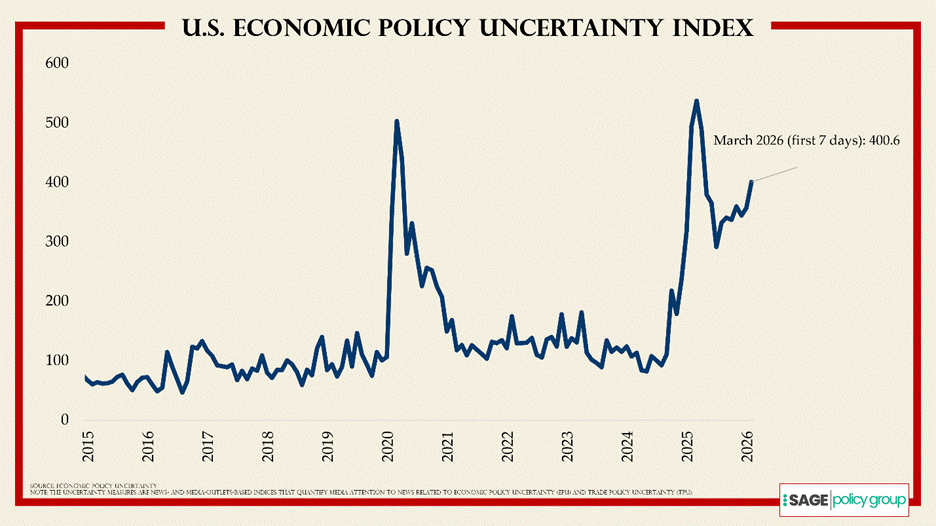
You can see the measure spiking as oil prices surge in response to the Iran conflict, and while uncertainty will lessen whenever that ends, we’re still way above the historical baseline.
Midterm elections are their own form of uncertainty, and we have a long way to go to get there. Even if the House and Senate flip, I have a hard time imaging them reigning in trade policy. Which is to say, I think uncertainty will stick around for a while.
What price inflation is directly resultant from tariffs?
Core goods inflation (physical things other than food and energy) is the first place to look. These prices have been rising at a less than 2% annual pace for the past year or so, but it’s unusual that they’re rising at all. Note that they consistently declined from 2012 to 2019.
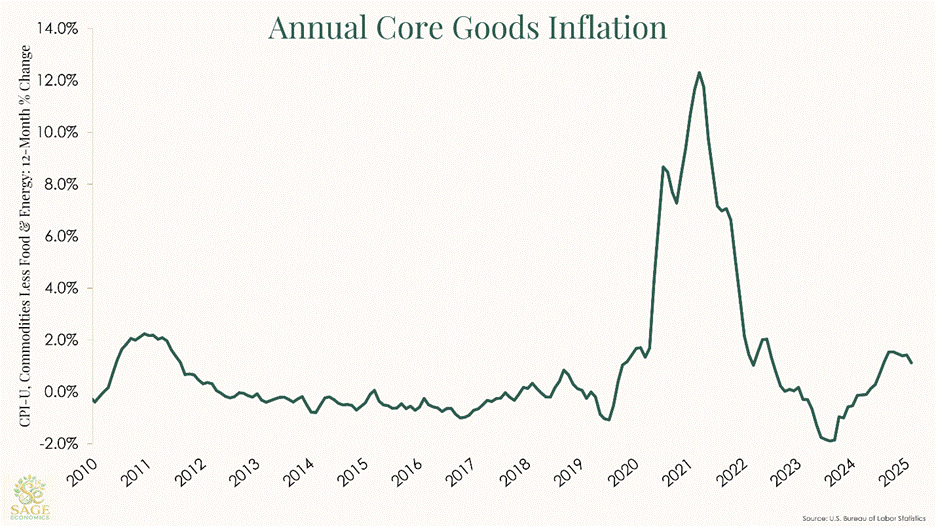
Consider TVs. A top of the line 65” plasma TV, which would look like garbage by today’s standards, cost $3,500 in 2012. A high end 65” inch TV now goes for less than $1,500. So if we add a 10% tax on the import of those TVs, and the business passes along even a third of that tax, those prices are suddenly rising.
That’s the case for how tariffs directly caused (in the past tense) inflation. I think the companies making core goods have, for the most part, already raised their prices to reflect tariffs.
This will be difficult to tell in the coming months because of other inflationary factors—like soaring computer component costs—that will specifically affect consumer products like TVs and laptops.
Is AI really causing layoffs?
I don’t think so, at least not en masse. If a company needs to lay off workers, “we’re using AI to enhance productivity” sounds a lot better than “our staffing levels got a bit bloated in 2021-22” or “we’re struggling and need to reorganize.”
And there aren’t many layoffs in general right now. About 1.75 million people were fired in December, which might sound like a lot, but it’s fewer than the 2015-19 monthly average (1.8 million/month).

More plausibly, AI is forestalling hires. Maybe a medical office uses an AI scheduler instead of hiring a second front desk person, or a research shop holds off on adding a research assistant.
Of course, a lot of people think this will change, and change rapidly, over the next few years.
What historical world economy do you think most closely represents the United States circa 2026?
Two comparisons come to mind, neither of which I think are particularly useful.
First up, England in the early 1800s. Automation, especially in the textile industry, caused largescale social upheaval, and there are similar concerns about the effects of AI. So far, those concerns are unjustified. England experienced a sharp increase in unemployment and a sudden decrease in wages. As of January 2026, unemployment is at 4.3% and real wages are at an all-time high. There’s also not a giant, ominous comet coursing through the sky.
Second, there are some similarities with the late 1920s/early 1930s. The U.S. had just emerged from a pandemic (the Spanish Flu in 1918-20), we had a massive increase in tariffs (Smoot-Hawley in 1930), and markets surged to all-time highs due to widespread speculation.
But this isn’t the 1930s. We have a services based economy, so tariffs won’t bite as hard. More importantly, investors aren’t leveraged up to their eyeballs right now. Seriously, people were buying stocks at 10:1 margins in the 1920s, which means that a 10% decline could wipe out their entire investment. I’m extraordinarily confident saying that even a large market drawdown won’t cause a 1929-style crash.
Who do you think the economy will be good and bad for during 2026 (specifically by income tiers)?
Income tiers is a difficult way to look at this because the economy tends to work better for those in the higher tiers (even if their incomes grow more slowly). It’s hard to fathom a situation where the top 5% struggle but the masses thrive.
I prefer to frame this as a job-havers economy. Given the incredibly slow pace of hiring and firing, it’s a great time to have a job and a terrible time to need one. This may sound obvious, but it wasn’t the case in 2022 when job switchers saw significantly larger pay increases than job stayers.
How will growing discontent with data centers affect smaller edge data center developments?
Discontent that manifests as community backlash will hamper hyperscale developments far more than edge ones. Discontent that manifests as legislation likely won’t distinguish between small and large data centers, and that’s going to be a problem for edge and smaller solo developments.
Even so, I think smaller projects will continue to have an easier time going forward.
On the graph Specialty Trade Contractor Employment by Subsegment from a few weeks ago: what’s the different between “New Single Family” and “For-Sale Builders?”
These data are categorized by what the employer primarily does. Employers in the new single family category primarily work on new single family homes, but they don’t sell them (i.e., they’re contracted by others to work on new houses). For-sale builders construct homes with the intent to sell them.
How does Maryland’s budget per capita compare to other states?
Maryland ranks 19th in state spending per capita, but that’s a little misleading. It’s best to look at state and local spending per capita, because the state/local division of responsibilities varies significantly between states. As of 2021, Maryland ranked 15th in terms of state and local spending per capita at about 5% above the national average.
It wouldn’t surprise me if we’re now ranked higher than that. Being above average is probably unavoidable; because Maryland has the highest median income of any state, our governments have to pay more in order to compete for talent.
That said, we spend on a lot of things we shouldn’t, and I’d reduce our spending were I the State’s benevolent ruler (note: I think it’s easier for benevolent rulers to balance budgets because they don’t have to worry about getting reelected).
AI and government budget cuts are going to kill the Eds and Meds economy nationwide. The superstar cities are dead meat.
I disagree! The Meds economy has an exceptionally wide AI moat; it’s highly regulated, physical in nature, and part of what you’re paying for is the ability to sue if something goes wrong. It’s also worth noting that healthcare has accounted for the vast majority of job growth over the past few years.
Regarding education: trouble is coming, but it’s not going to touch the superstar cities. I’m worried about small towns economically dependent on nonbrand name colleges. Austin will be fine, but places like Macomb, home to Western Illinois University, are going to have a hard time.
I have pharmacological firms pledging to spend $500 billion over the next five years (maybe half of which is construction). How does this compare to the data center boom? Will the industries have issues handling these megaprojects with the data center boom already in effect?
We’ve spent more on chemical manufacturing construction ($43.1 billion) than we have on data centers ($39.3 billion) over the past twelve months. So even without a pharma boom, this is already a huge segment.
Regarding the boom part, I expect this to be a lot different than what we see with data centers. That $500b number comes from a trade group and is probably a little exaggerated, but let’s be generous and say 30% of it goes toward construction put in place and that occurs over the next decade. That comes out to $15 billion a year.
That’s a lot! But it’s not transformative, and I imagine some of it covers spending that’s already occurring in the chemical manufacturing segment. Which is to say, I expect the category to remain strong, but it won’t show the kind of rapid growth we saw with data centers.
As to whether the industry can handle it: I’m a big believer in the elasticity of supply. If Eli Lilly wants to build a $3 billion plant in Pennsylvania, contractors will gladly rise to the challenge regardless of how much data center work they have under contract.
