


Thanks for submitting questions. We got way more than we could answer (if we didn’t get to yours, shoot us an email and we’ll try to respond). This Q&A starts with Anirban’s responses to some wide ranging questions and ends with Zack’s responses to the data center/AI/climate change ones.
Anirban’s Answers
With TSA numbers lower in 2026 than in 2025 and higher gas prices, how do you see domestic travel developing over the next 12 months?
I think air travel stands to be weak. Airfares have climbed rapidly, in part due to jet fuel prices, but also because of trimmed capacity. United Airlines slashed nearly 5 percent of its planned domestic seat capacity for a significant segment of the summer. That removed more than 23,500 domestic flights from July through early September.
My guess is that many families are shifting away from fly-to destinations to drive-to destinations. They save on airfare and by staying closer to home probably save on some other costs as well. We understand why this is happening, don’t we? Inflation remains high, job growth has become more erratic, and wage growth has softened.
“Aging in place” and a gray “tsunami” coupled with fast rising home prices are a big problem. What are the economics of ADUs and other similar measures? How can we provide for individuals, young couples, etc. to be aligned with an aging population for housing needs?
ADUs are accessory dwelling units. The number of units is rising across much of the nation (zoning/codes can frustrate development). Los Angeles County, for instance, reached a milestone with 10,000 ADUs constructed in 2025. According to Mesocore, the ADU market will expand from around $20 billion today to $43 billion by 2034.
With housing affordability shrinking and elderly population rising, ADUs represent a GREAT way for families to save money, provide support and companionship for the aging, and to enhance property value. These units can also be used to support young people not yet ready to leave the nest. Expect more ADUs, but also expect more community opposition to them since they also can be used as rentals.
What do you think of the statement: “Mercantilistic economies like China & South Korea, export unemployment?”
Look, I get it. We have been running large trade deficits with a number of societies. That may or may not be an indication of unfair trade. I’ll admit to liking the concept of free trade, but fair trade needs to be part of that bargain. I think America has made its point. If we are to open our markets to others, they must in turn open their markets to our manufacturers, service providers, etc.
Without question, unfair trade has hurt American manufacturing in recent decades. That has produced unemployment in industrial communities across the nation. Tariffs are viewed as a mechanism by which to reindustrialize America. But I think there are other ways that are more productive, including training of a 21st century industrial workforce, better zoning to allow industrial development, much lower electricity rates (c’mon America), and stepped up documented immigration of those in other nations that are critical to manufacturing, including engineers.
The consensus GDP growth forecast for 2026 remains in the 2% area. Industrial Production has been improving recently. Is it fair to consider this trend as supporting or confirming the sturdy 2% growth expectation?
Statistically, industrial production encompasses the real physical output of manufacturing, mining, and utilities. With America reindustrializing, expansion in industrial production stands to be a support for overall GDP growth for many years to come. If one looks at construction employment growth over the past two years, the region that has grown the most over the past two years among the 25 most populous metropolitan areas in the U.S. is Houston. That says a lot.
At the same time, the manufacturing industry has lost 265,000 jobs since the start of 2023, and ask any manufacturer: it’s painstakingly difficult to fill industrial jobs these days.
More broadly, industrial production simply isn’t the economic driver it once was. Instead, it’s the U.S. consumer who has taken the wheel.
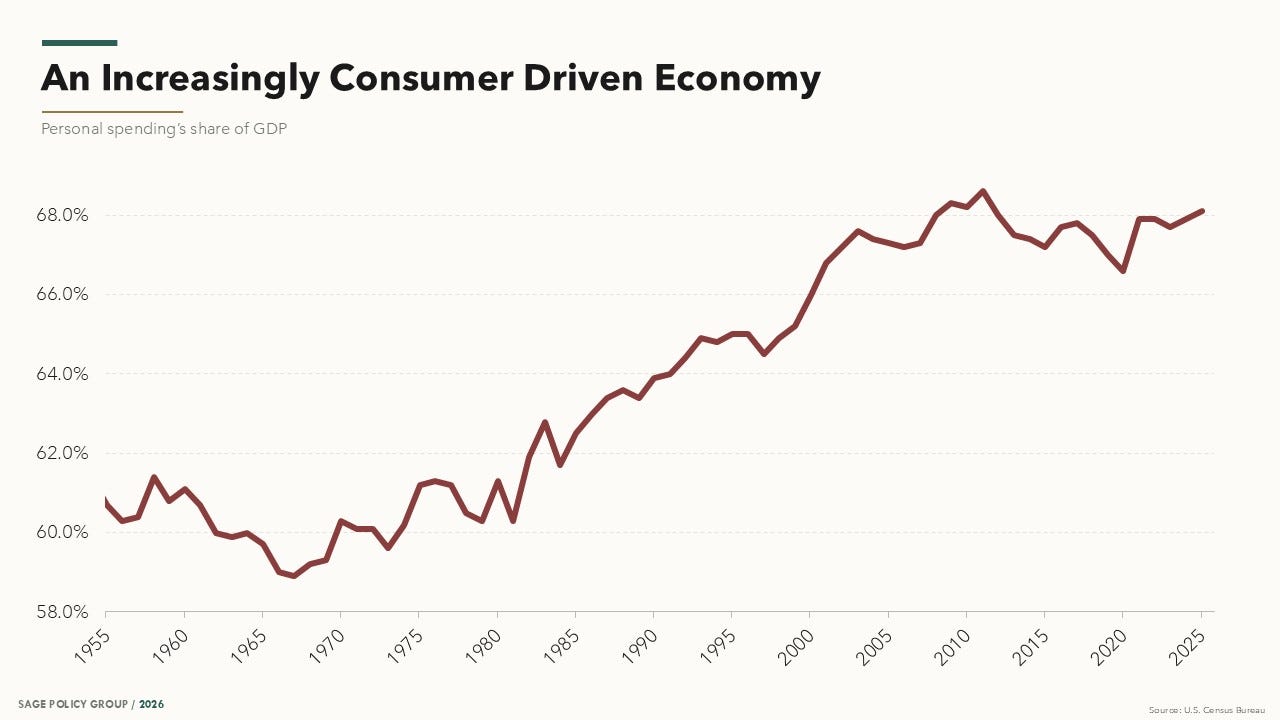
So while reindustrialization will certainly help support growth, it’s far from the more important factor influencing forecasts.
Could you talk about the impact of demographics on the sturdiness of consumer spending, specifically as it relates to the “Graying” of America.
According to Federal Reserve data, Baby Boomers (born 1946-64) represent less than 20 percent of U.S. population, but hold a bit more than half the wealth. This group is no longer spending on college tuitions (probably – maybe as grandparents I suppose), and has seen their property values explode and their financial portfolios bulge. A few decades ago, we could not have imagined the asset price appreciation that has transpired. These folks are collectively far wealthier than anticipated.
It has also been a very fortunate generation, with many enjoying their peak earnings during the fabulous eighties and nineties. So they spend. But that also means that the places they’re leaving (New York, California, Maryland, etc.) are losing a lot of spending power while the places they’re going to (Florida, Arizona, South Carolina, etc.) are experiencing benefits of the bulge.
Homes are too expensive and that is unlikely to change since demand exceeds supply of affordable homes. Could commercial to residential conversions be the answer? Do you know of examples or stories of where this is happening that could help affordable living?
There are of course many examples of commercial to residential conversions, but often those conversions have been associated with higher rents. After all, these conversions are often wickedly expensive and these buildings are often in very prestigious parts of cities (e.g., historic central business districts). Given the cost of labor, construction materials, and elevated interest rates, I think it will be rare for commercial conversion to translate into affordable housing. An exception to this might be vacant shopping centers. Often, redeveloping these into living spaces is a bit less expensive, there is surface parking all around, and residential units are often quite small. That seems like a decent recipe.
I thought the DMV economy would crater as a result of DOGE’s DRP resignations, presumed migration out of the area, and some government contracts that were terminated abruptly in 2025. But it hasn’t, or at least it doesn’t feel like it has. Why not?
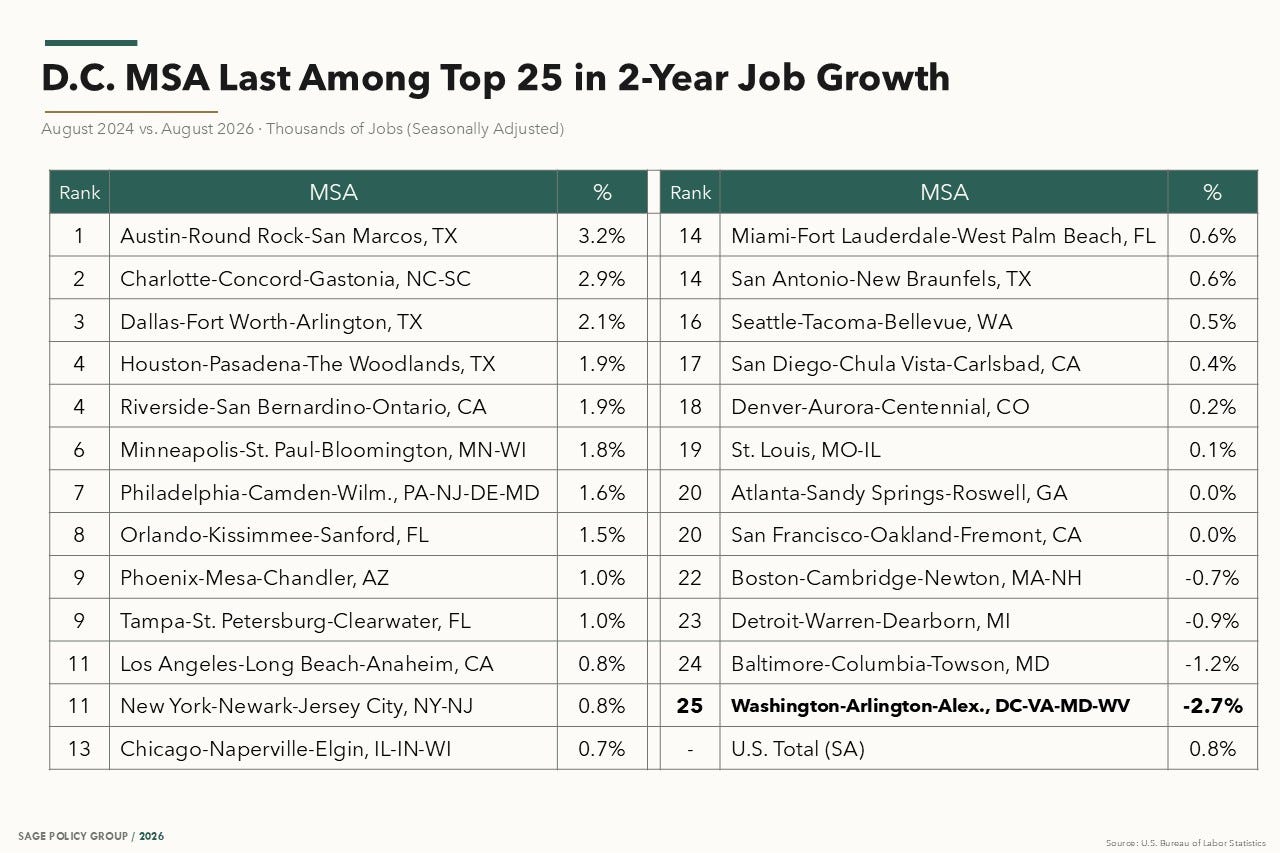
Actually, I think the DMV economy has taken a major wallop. Among the 25 most populous metropolitan areas, none has lost jobs at a faster clip than the Washington metro. Somehow, there is still a lot of traffic, but we’ve suffered massive job loss and the local federal contracting community has been severely impacted. I wouldn’t say the economy has cratered, but it has taken a major step backwards.
What would YOU recommend to solve Social Security and what do you think is the most politically viable solution?
Obviously, we can continue to raise retirement ages as one partial solution. But that’s hardly enough. Even with that, the Social Security Trust Fund is set to become insolvent by the end of 2032.
So we have to do more. The most obvious thing would be means testing. We probably need to treat Social Security as genuine social insurance. For those who made a lot of money over their careers (those who won capitalism), we may need to harshly limit payouts. Oh, I know that’s not popular. I’m not running for office. I’m just trying to answer your question.
We could also (more controversy forthcoming) step up documented immigration. We need more taxpayers. Rather than taking more out of the paychecks of the young, it might be nice to have more people paying into the system.
I believe that we are creating a caste society. The tax reform that significantly increased the standard tax exemption reduced the tax incentive for home ownership - the wealthy will own property and build generational wealth, the others will be renters for life. And, expanding 529 accounts down to primary education (not just secondary) provides the wealthy (the better off?) with tax incentives/advantages to send their children to private school - further separating the have’s from the have not’s. Thoughts?
I agree that America is bifurcating. When I was growing up in a farm town in Illinois that also happened to have a regional medical center, there was a large middle class. There weren’t that many really rich people and there weren’t that many really poor people (more poor than rich, though). That community, Kankakee, Illinois, also had a sizable manufacturing base (I played little league baseball for the Massey Ferguson Tractors). Between agriculture, healthcare, and manufacturing, there were plenty of middle income jobs.
But during the intervening decades, asset values have surged. Those who owned those assets have become far wealthier. Various technology cycles have further concentrated wealth. There was no Google when I was growing up, no IPhone, no Internet, no commercialized artificial intelligence, etc. While stockbrokers made plenty back then, it was nowhere near what leading financiers make today.
So wealth has become hyper concentrated. Many of the young, in particular, are falling behind. That is why they are opting for democratic socialism in many instances—they don’t think the system is fair and they don’t think they can make it. And it’s going to get worse with AI standing to dislocate many young people while enriching others. Bottom line: at some point, politics in America are going to change, and not in a way that favors free enterprise.
What are some items/policies that the governor could quickly change to encourage businesses to invest in Maryland?
I don’t know if you’ve noticed, but Maryland has suffered a spate of layoffs recently. Among them are Amentum, a defense contractor in Anne Arundel County that filed notices to lay off 382 workers; Crosby Marketing Communications in Annapolis, which is cutting 20 workers; WBAL NewsRadio; WMAR-TV; the University of Maryland, College Park (84 State-funded employees); Stanley Black & Decker, which is closing its Carroll County manufacturing facility eliminating 55 jobs; Thriftbooks, which is closing its Baltimore County warehouse and laying off 136 workers; and Savista, a global company that assists hospitals and medical practices manage billing, insurance, etc. – the company plans to lay off 39 employees in Bethesda.
In my judgment, Maryland’s standard of living is in sharp decline. The state was hammered last year by federal government and spending cutbacks that took the form of steep agency layoffs and diminished funding for research and nonprofits. Many of our most successful citizens are leaving, whether for Florida, Delaware, South Carolina, etc. So what can a governor do? Two things come to mind.
Cut the corporate tax rate—at 8.25%, it’s not competitive. We need to attract much more private investment to offset diminished federal support;
Get that bridge up already—I figured the State of Maryland would botch this. The Key Bridge collapsed in March 2024. Two and a half years have passed and there simply has not been enough progress. Cost estimates are spiking, and of course they are. Of course, Maryland isn’t alone here. The federal government has actively hindered efforts, and the White House’s trade policy is the primary factor behind those rising cost estimates.
Zack’s Answers
If you were advising a local government that was considering a moratorium on new data centers, what would you tell them?
I’d tell them:
First: It’s their job to convince local residents that data centers are a good idea. These debates have shown me that people simply do not care if their county is going to reap massive tax benefits several years down the road. Maybe they don’t trust the officials to spend that money wisely. Maybe they don’t even plan to live their a few years later.
It’s really great if a county can pay for a new school in cash instead of financing it, but does that matter to the average voter? Probably not.
So what would move the needle with constituents? Well, the idea that data centers will allow tax cuts—like we’ve seen in Loudon County—is pretty appealing. And while that won’t be feasible in many cases, specifically enumerating what the county plans to do with the new revenues would be a good first step.
Second: they need to stress that data center-supported tax revenues really are transformative. Look at Quincy, Washington, a farming community of about 8,000 people. About 60% of the town’s property tax revenues now come from data centers, and that has paid for a new high school, hospital, library, police and fire station, and other infrastructure upgrades.
Or look at the rural Louisiana school district whose teachers will get $50,000+ bonuses (!!!) because of data center-related tax revenues.
Fourth: while a lot of the arguments against data centers are overstated, acknowledge that they do need to be situated correctly. There are a few that most definitely are not (the xAI Colossus data center in Tennessee comes to mind…), and this sucks both for the people near them and broader efforts to build more data centers.
Big picture, data centers have to go somewhere, and local governments might regret it in a decade or two if they don’t capitalize on capturing those tax revenues.
How are “temporary” data center moratoriums impacting local economies?
In the short term, the effects are likely limited to less construction activity (there’s a reason unions are extremely pro data center).
To the extent these moratoria are indeed temporary, longer-term impacts could be pretty small. But that’s assuming that developers don’t abandon the potential data center projects that are delayed by the moratoria.
What sector of labor is most under threat to lose jobs to AI over the next year to 3 years?
First of all, we really don’t know. If you look back at what jobs people thought the internet would disrupt, they were pretty wrong. I think the same thing will happen with AI, and we’ve definitely seen that so far. AI is great at writing code, and yet software developer job posting on Indeed have risen 25% since May 2025.
But if I had to pick, I’ll say administrative office workers. To be clear, I think these jobs will still exist, but there will be fewer people doing them because of how much of it can be augmented by AI.
The fields I think are safest are construction and healthcare. For the former, it’s notoriously difficult to make a robot that can lay bricks, and for the latter, regulations and the nightmarish idea of a robot cutting you open are probably going to maintain the status quo for a while (someone else can test the first catheter-placing robot…)
But really, who knows? Maybe AI will come for the economic consultants.
How do you believe artificial intelligence will affect the economy over the next three to five years, particularly in industries that rely on technical expertise and professional services?
The Financial Times published this graph showing the range of outcomes from human extinction to the end of scarcity. So there’s a pretty wide range of outcomes from here.
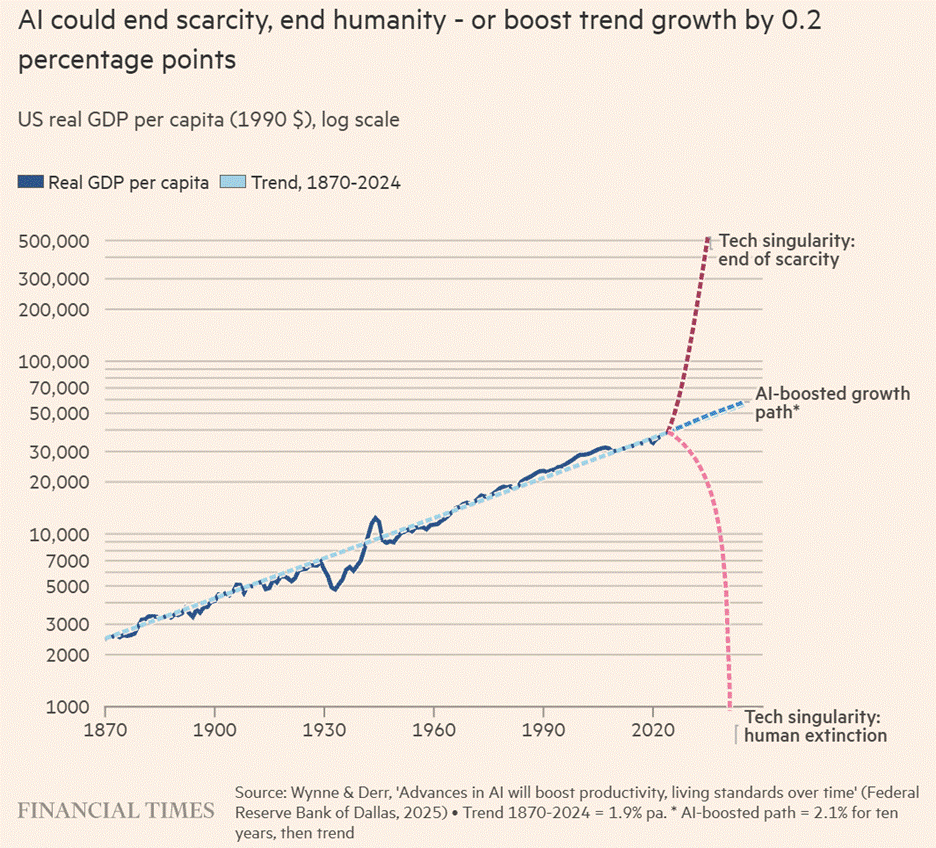
I think AI will make people more productive to some degree, and it’s going to increase the quality of output in certain sectors.
That said, I don’t think the effects will be as transformative as some expect. Can Claude or Chat GPT do a lot of what a business consultant does? Sure, and yet Anthropic (the makers of Claude) just hired Accenture.
I just don’t think AI is coming for technical experts in the near term (hopefully those aren’t the famous last words of this technical expert), though it may hurt entry-level hiring.
More broadly for the economy, I think people have very different definitions of “transformative.” I’ve seen many predictions of double-digit percentage GDP growth, which just isn’t going to happen if you ask me.
A more reasonable—and still transformative—outcome is an acceleration of 1 to 2 percentage points of GDP per year over the next half-decade. Sounds like small potatoes, but consider that if Panama had 1.5 pp faster growth since about 1980, it would have higher GDP per capita than the U.S. right now.
How does the potential AI “bubble” compare in size to the dot-com bubble? The numbers at play today seem almost too large to reasonably comprehend.
In some ways—like tech’s share of major stock indices—it’s already larger, and has also spread to more segments of the economy. The dot-com boom didn’t materially impact the construction industry, for instance, but data centers currently account for about 8% of all private nonresidential activity.
But this is way less bubbly than the dot-com boom. In 1999, the valuations on unprofitable companies were just silly. Forward price-to-earnings ratios were like 50x earnings (and higher for a lot of companies). There was just a ton of money flowing into companies that hadn’t proved they could make money. The AI darlings, on the other hand, are huge companies with strong cash flow.
This could change. Ask again next year and my answer could very well be different.
On a macro level, how does climate change affect our economy?
The longer-term effects of climate change are really uncertain, and that means the longer-term economic impacts are also hard to predict. A 2024 Congressional Budget Office report’s central estimate has GDP 3% lower in 2100 than it would have been if temperatures remained unchanged. So, not great, but tolerable.
The higher end estimates from that study are a lot worse, and other studies’ predictions are even more pessimistic.
In the shorter term, a warming climate is going to reduce labor productivity, especially in areas without air conditioning and where a large share of jobs are done outdoors (neither of which really applies to the U.S.). Just 8% of U.S. workers spend at least one third of their day outside, and 65% don’t have to do any work outside at all. The global share is significantly higher.
But the big answer here is that there’s not even close to an expert consensus.
What’s Next
Next up is Week in Review, our every Friday post that gives you everything you need to know about the economy in a breezy, five-minute read. Week in Review is just for paying subscribers. If that’s not you and you want it to be, just click the button below.