


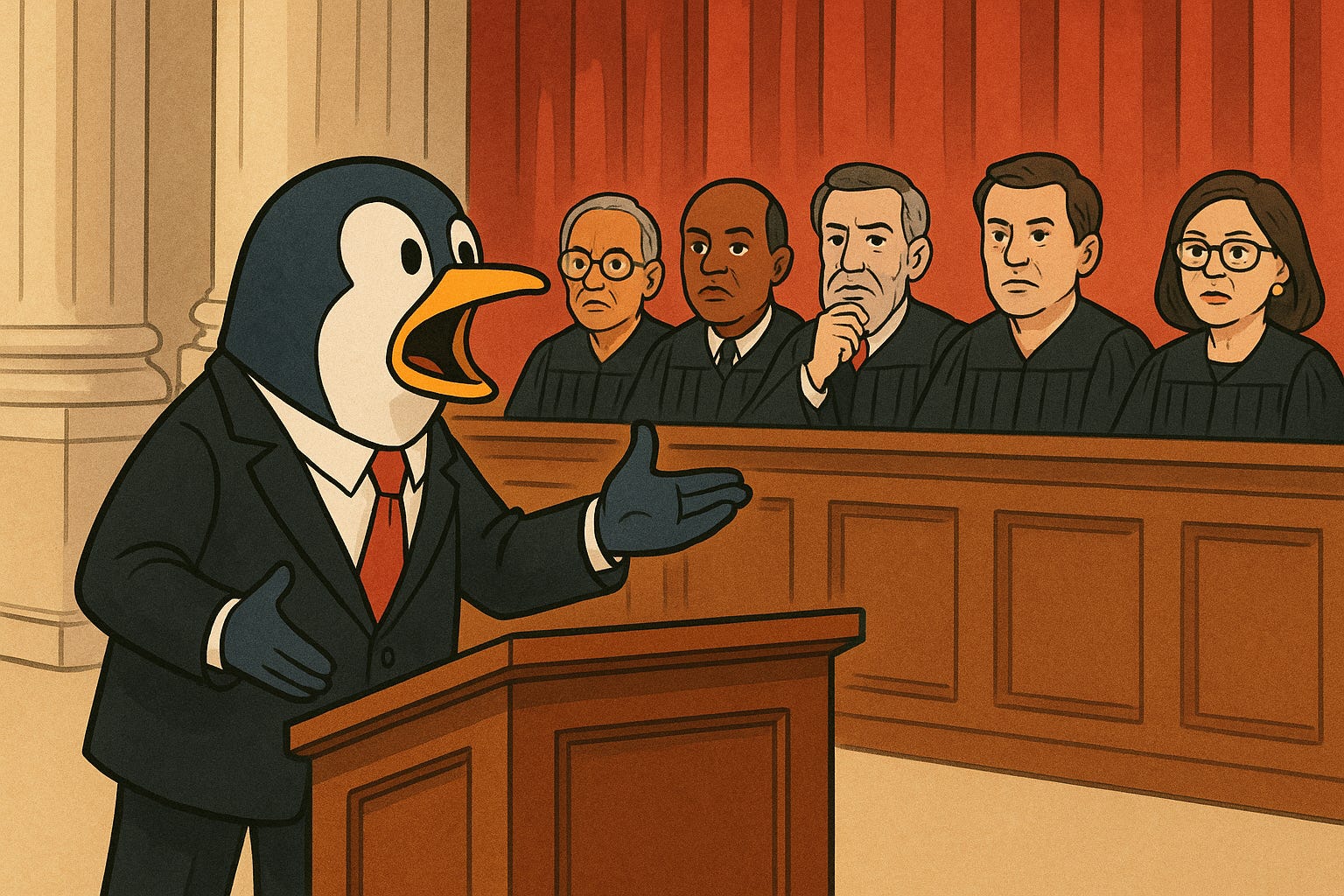
The Supreme Court will start hearing oral arguments on the legality of Trump’s tariffs today; Learning Resources, Inc. v. Trump will decide whether a president can use the International Emergency Economic Powers Act (IEEPA) to levy tariffs to their heart’s content.
We wrote about this at length a few months ago, but here are a few additional (and more current) thoughts:
This is huge (Big!) for the fate of the trade war. Some tariffs, like those on steel/aluminum/copper would remain in place, and there are workarounds to replace some of the IEEPA tariffs, but this would dramatically reduce the pace of tariffing.
There were 44 amicus briefs filed for this case, 37 of which were against the tariffs. A majority of the briefs against the tariffs came from conservative groups, and that’s very unusual.
Learning Resources is a family-owned toy company based in Illinois. It says a lot that the challenges to tariffs have come from smaller companies and trade groups, but that’s who’s hurt here. The massive corporations are sucking up in hopes of getting exemptions (with pretty good success so far) while the smaller companies are stuck with the bill.
There’s no firm timeline on when the Court will make a decision. It could be by the end of the year, or it could well into 2026.
If the IEEPA tariffs are overruled, the government will have to refund any revenues collected through them. Notably, those revenues will go to the companies that paid the tariffs, not the consumers who had the costs passed on to them.
The best trade news of the week
Chinese President Xi Jinping and Nvidia were pressuring the U.S. to allow Nvidia to sell China advanced chips. Makes sense. Nvidia would get a massive sales boost, and China would get a massive technological boost.
Makes less sense for the U.S., who would be sacrificing a key technological advantage (as many warned last week).
Thankfully, the Wall Street Journal reported on Monday that Trump Officials Torpedoed Nvidia’s Push to Export AI Chips to China.
10% additional Canadian tariffs nowhere to be seen
President Trump, angered by a commercial Ontario put out that showed Reagan criticizing tariffs, announced 10% additional tariffs on Canada. But that was on October 25th, and we’ve yet to see any implementing orders. It could be that he changed his mind, or it could be that he didn’t want to strengthen the argument against his tariffs in this week’s IEEPA Supreme Court case.
U.S.-China trade deal
Whatever the point of 2025 tariffs, it’s apparently not to decouple with China. The deal announced on Saturday lowers Chinese tariffs to a level that’s comparable with (or maybe lower than) tariffs on key trading partners like India, Brazil, or Vietnam. Given Chinese efficiencies and general trade policy unpredictability, you won’t see many companies shifting production out of China in the near term.
What’s Next?
This week brings us some jobs data (not necessarily the jobs data we want), some other private sector releases, and hopefully news on the government reopening. We’ll cover all that and more in Week in Review, our every-Friday post that gives you everything you need to know about the economy in a breezy, five-minute read.
Week in Review is only for paying subscribers. If that’s not you and you want it to be, just click the subscribe button.
Correction to my POTUS drawing, it’s common acronym is SCOTUS. I should have drawn POTUS as a shadow in the background. Thank you for replying to my cartoon. I offer to you my revision os SCOTUS Class of 2025