


It’s a great economy for higher income households and a terrible one for lower income households.
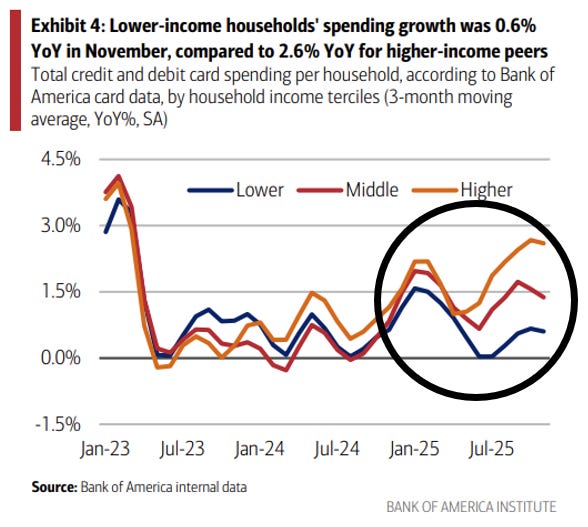
That’s the prevailing narrative, anyway, and one widely deemed The K-Shaped Economy, a name derived from graphs like this one from Bank of America (we added the black circle).
Line goes up for higher income households, line goes down for lower income households.
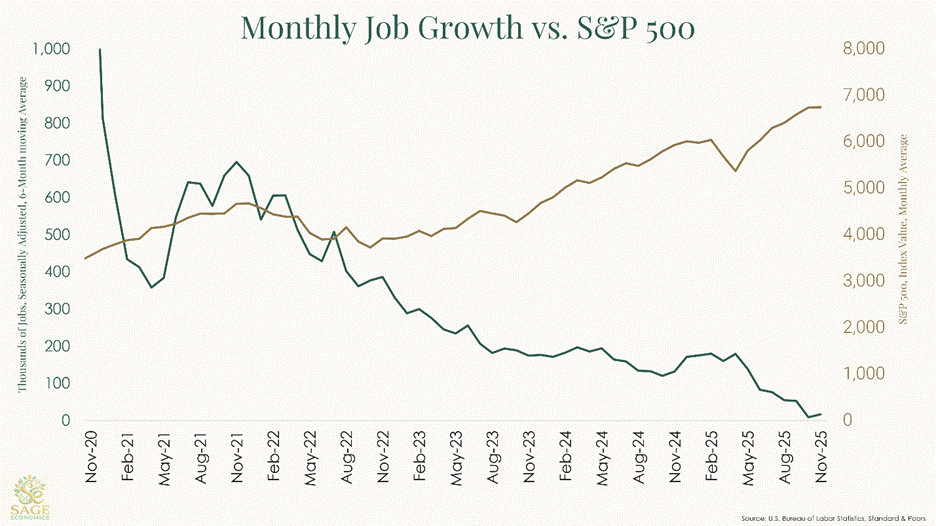
Another example: job growth slows, which hurts the masses, while stock prices soar, which helps the wealthy.
Talk of the K-Shaped Economy is everywhere. Media outlets like the NYT, Financial Times, LA Times, Business Insider, Yahoo Finance, Fox Business, CNN, Bloomberg, NPR, AP, and, well, you get it, have covered it.
Bloggers, from Nobel Laureate Paul Krugman to Gen Zer Kyla Scanlon and virtually everyone in between, have added their takes.
So why shouldn’t we chime in too?
There’s a Better Framing than the K-shaped Economy
The K-shaped story is, in many ways, undeniably true: inflation disproportionately harms lower income households, stratospheric stock prices disproportionately benefit higher income households, higher borrowing costs are harder on those who need to borrow more, etc. etc.
But there’s another way to frame who this economy is helping and who it’s hurting: it’s a great time to have a job and a horrible time to need one.
And that’s because businesses just aren’t hiring. 2025 was the worst year for hiring since 2012. To give that some context, 12 million fewer people were hired during the first 11 months of the year than during the same period of 2022.
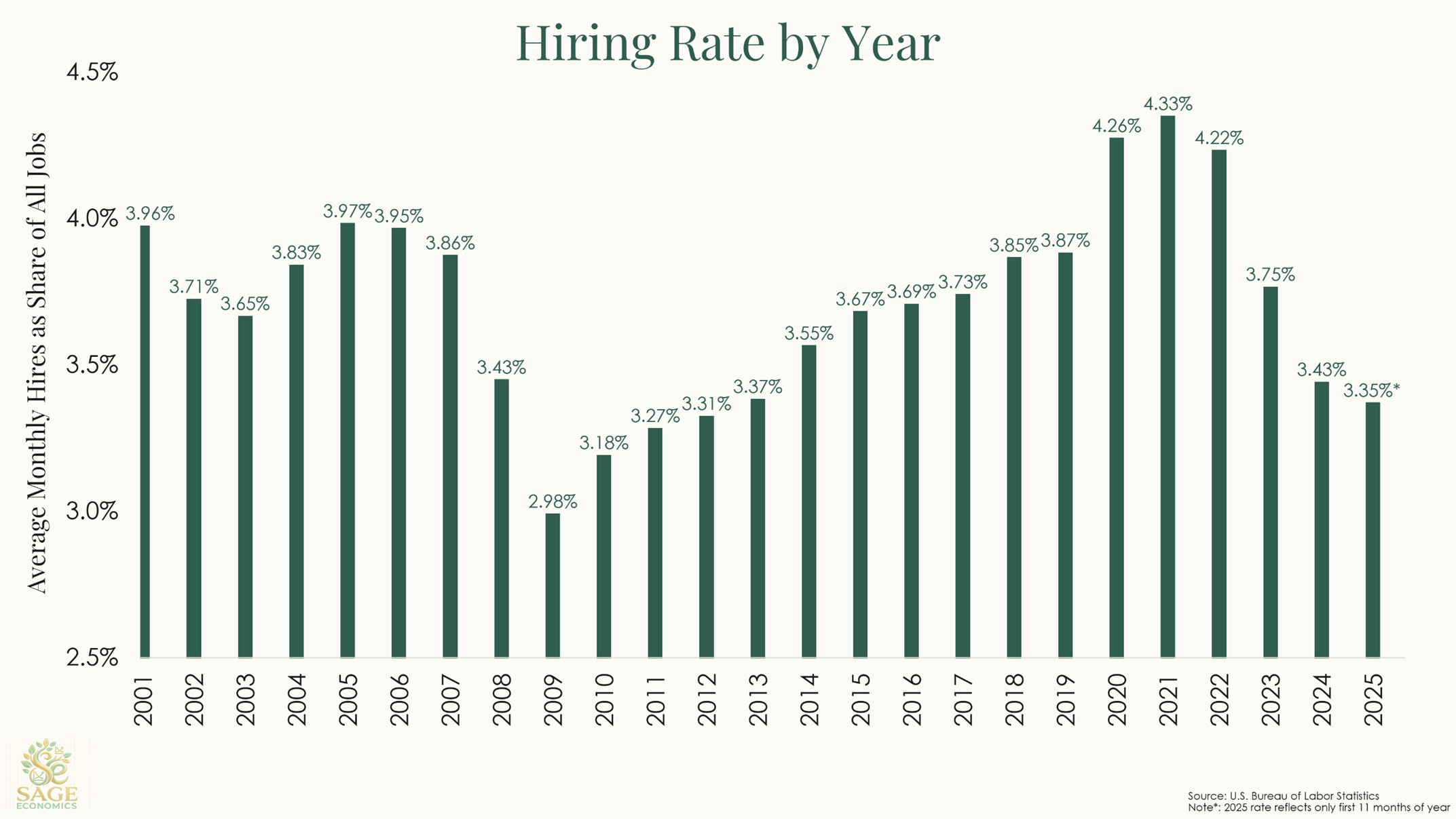
So it’s extraordinarily difficult to find a job. That usually means people are getting laid off en masse, but that’s not the case right now. Fewer people were fired in 2025 than in any year between at least 2001 and 2020 (just comparing the first 11 months of each year).
At the same time, wages have grown at a much faster pace at the bottom of the income distribution over the past several years (BLS doesn’t have data for the fourth quartile).
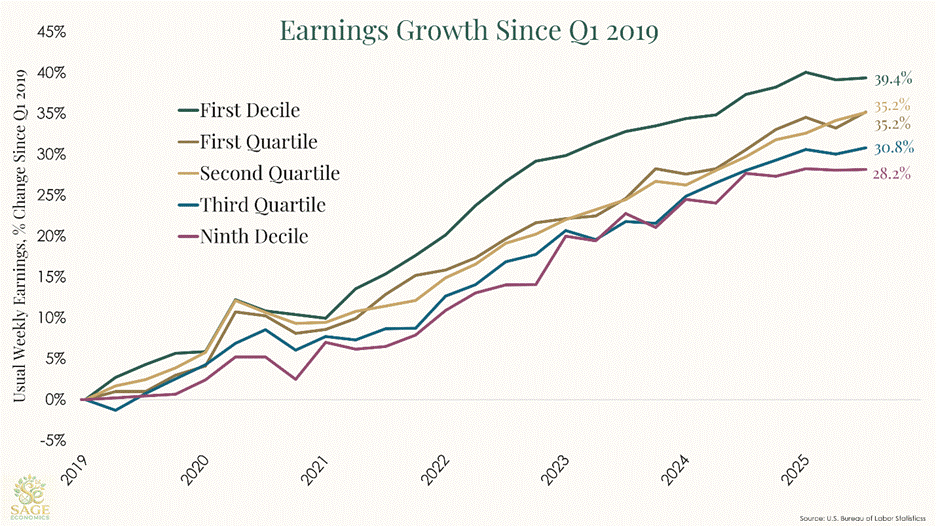
So low earners are unusually unlikely to be laid off and have seen relatively rapid earnings growth. That doesn’t change the fact that they’re struggling under the weight of some very real K-shaped dynamics, but the biggest victims of current economic dynamics are those who need a job—largely, but not exclusively, young adults.
What’s Next
We’re going to try to do a weekly post on this topic—the K-shaped economy and the difficulties facing job-needers—until we run out of things to say about it. Some of those will only be for paying subscribers. If that’s not you and you want it to be, just click the button below:
Paying subscribers also get access to Week in Review, our every Friday post that gives you everything you need to know about the economy in a breezy, 5-minute read.
Want to Work With Sage?
Of course you do. Contact us at info@sagepolicy.com to learn more about booking speaking engagements, commissioning impact studies or policy research, or adding a fractional economist.