

Here’s nine snack-sized economic (or at least vaguely interesting) tidbits to get you to the long Holiday weekend.
Thanksgiving Dinner Prices
The cost of your Thanksgiving dinner rose for the first time in four years, up 6.3% nominally and 2.24% after adjusting for inflation, according to the American Farm Bureau.
Or maybe it fell 0.4%, if we’re going off this Wells Fargo Agri-Food Institute report. Or maybe it increased 0.5%, if you’re including beverages, according to that same Wells Fargo source, with the largest increase in sparkling water prices (tap is just fine for us, thanks).
Longer term Thanksgivingflation has been relatively tame. The price of an average Thanksgiving dinner is up less than 18% since 2016, while economywide prices are up nearly 40% over that span.
Is Red Meat Actually Bad for You?
There’s a well-established association between eating red meat and heart disease, but it’s hard to show causation given confounding diet/lifestyle factors.
But some people, following tick bites, develop alpha-gal syndrome, which is essentially a vicious allergy to red meat. By comparing people with alpha-gal syndrome to others who sought care for a tick bite but didn’t develop the allergy, this study found a range of small but measurable reductions in weight and LDL cholesterol, among other modest improvements, for those who had to stop eating it.
Does 50% of Martha’s Vineyard Have Alpha-Gal Syndrome?
HHS Secretary Robert F. Kennedy Jr. claimed that 50% of people living on Martha’s Vineyard have alpha-gal syndrome. That claim is, as you might expect, false. Nearly half of Martha’s Vineyard residents tested for the syndrome have it, which is very different than half of the residents having it.
Even so, there have been over 1,000 positive tests at Martha’s Vineyard Hospital the past few years, and that’s way too many.
Misunderstanding aside, RFK Jr. laudably announced a pretty sweeping plan to combat ticks and tick-borne illnesses earlier this year. This is great. Kill them all.
Data Centers Lower Electricity Costs in Alabama
Alabama Power announced that it’s lowering rates in 2027, stating that the “reduction is driven primarily by increased revenue expected in 2027 from large-load data centers.” A residential customer using 2,000 kilowatt hours per month will save over $100 next year as a result.
Hiring: A Repo Man for Outer Space
SpaceX has a $43 billion debt deal that is secured by the advanced AI chips the funds will be used to purchase. The lenders tried to introduce a provision preventing those chips from being shot into space (it’s unclear if that made it in the final agreement), because how do you repossess collateral that’s outside of Earth’s atmosphere?
American Emissions Progress
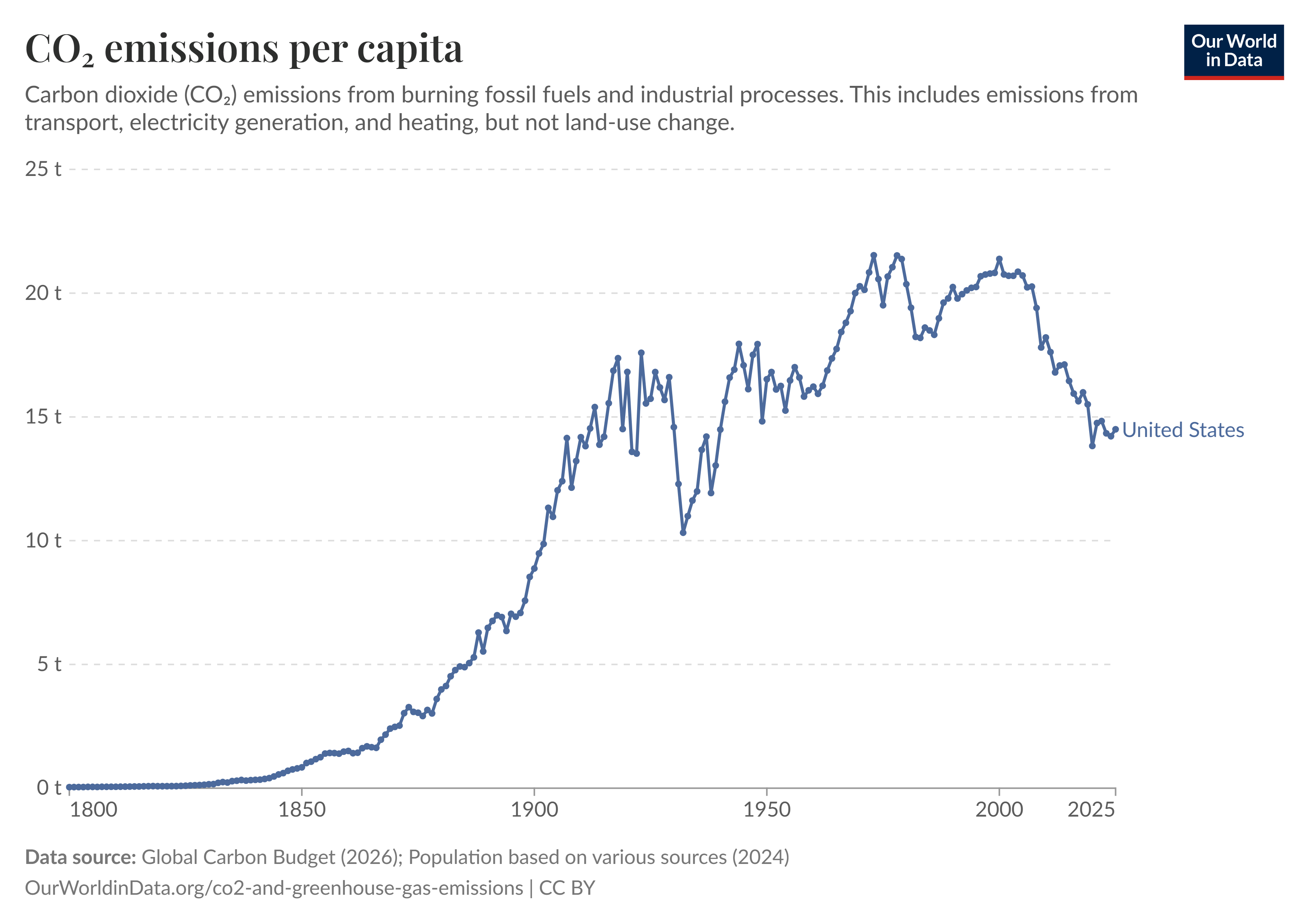
U.S. CO2 emissions per capita, down 32% since 2000, are lower than they were in 1912. Total U.S. CO2 emissions are lower than they were in 1990 despite a population that is 37% (92 million people) larger.
Grand Theft Gamers’ Money
Last week we wrote about the release of Grand Theft Auto VI, the most anticipated video game ever. That anticipation translated into a truly absurd $3.79 billion in sales in the first 24 hours of the game’s launch. To put that number into context, $3.79 billion is:
3x more than the record opening weekend box office for a movie (Avengers: Endgame at $1.22 billion).
More than Avatar, the highest-grossing film ever, made worldwide in its entire box office run ($2.92 billion).
1.9x the $2.01 billion raised by all presidential candidates in 2024.
So, that’s a lot.
Florida Counties Grapple with Amendment 3
A few weeks ago we wrote about Florida’s recently adopted Amendment 3, a vastly expanded property tax exemption that will severely cut local tax revenues. Manatee County commissioner George Kruse wrote a Substack piece about how he intends to address their roughly $100 million budget shortfall.
First, this piece is incredibly thoughtful and transparent. More public officials should put their approach to governing in long-form writing.
Second, Kruse is adamant that he won’t bridge the shortfall with new taxes or fees, which he rightly claims would be highly regressive and harmful to the very households Amendment 3 is supposed to help.
Third, he lists 13 things the County will do immediately to hash out its approach to bridging the gap. These include:
Halting every CIP project that hasn’t broken ground.
Unwinding all TIFs.
Eliminating all discretionary nonprofit funding.
But maybe the most interesting one, posted below verbatim, is:
We need to reimagine our infrastructure. We cannot build out any more roads or widen what we have. The construction isn’t the issue due to impact fees. The maintenance is the issue. We are already well behind on infrastructure maintenance today and every mile of new road will require new commitments for milling, paving, lining, and repairing of potholes. This future obligation for current roads is already going to be tough on future budgets without expanding it. We need to put our money into lower-maintenance options to ease traffic like intersection improvements, roundabouts, sidewalks, and trails. Projects that can take cars off the roads and help with traffic flow without the burden of future, endless costs and expensive maintenance.
How Is AI Diffusing Through Businesses?
The businesses getting the most out of AI have substantially reworked their organizations around the new technology, according to this report by Anthropic, and most value generation came from expanding what their business does rather than reducing costs.
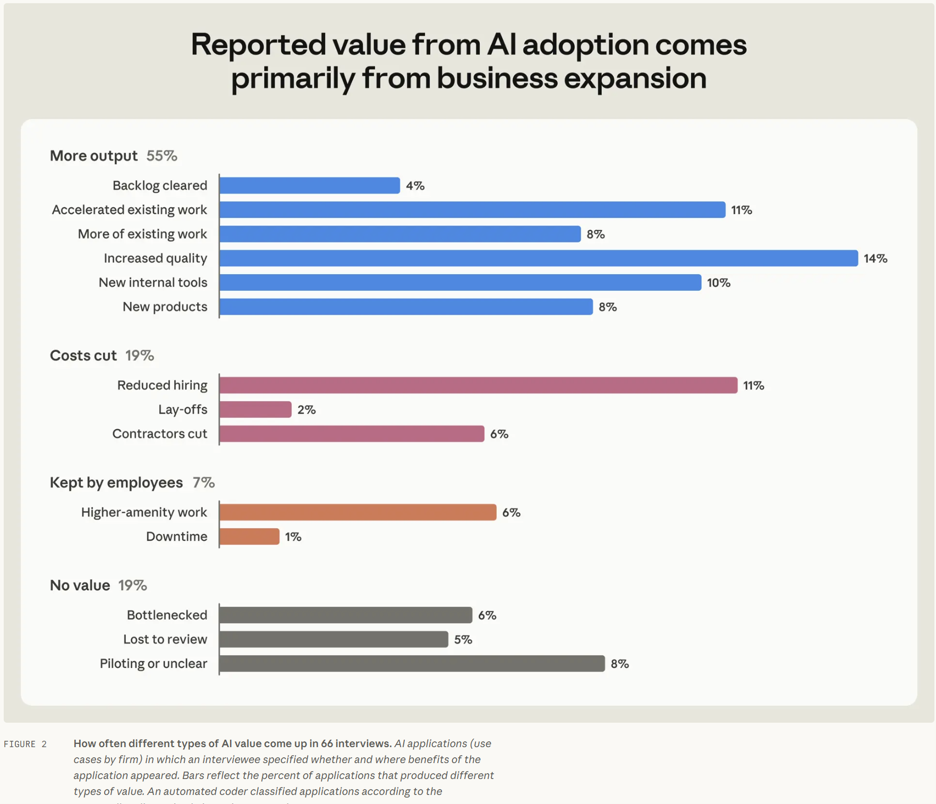
The report found “very few examples of domestic layoffs that were driven by AI automation,” though most companies they spoke to reported hiring fewer new workers because of AI. That’s consistent with the current low-hire, low-fire labor market.
What’s Next
Next up is Week in Review, our every-Friday post that covers all the economic news and data in a breezy, five minute read.
Week in Review is only for paying subscribers. If that’s not you and you want it to be, just click the subscribe button.