


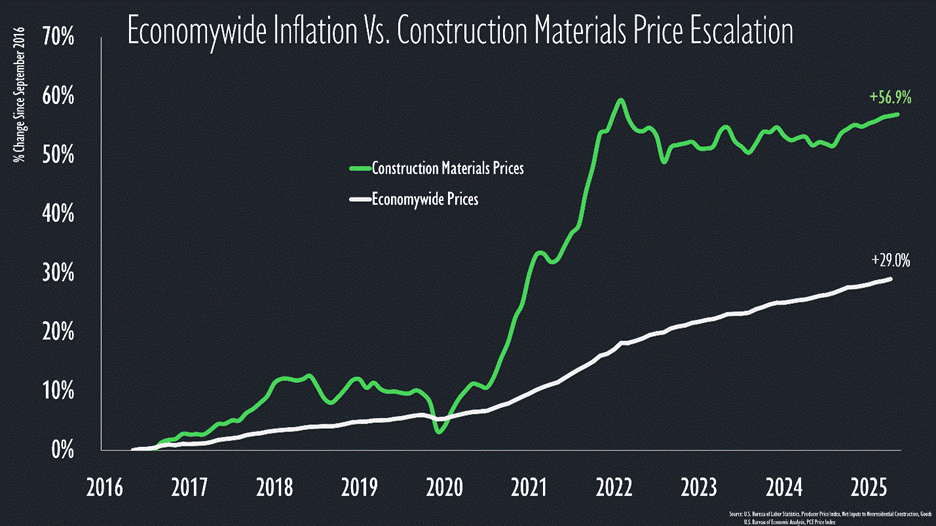
I mislabeled a graph in this week’s Construction Trend Tuesday. The corrected version, included below, is now also in the online version of the post.
The downside: I don’t like making mistakes. Sorry about that!
The upside: it turns out a lot of you actually read this stuff. Many thanks to the dozens of readers who like instantly pointed out the error.
While I’m getting things off my chest
A few weeks ago I shared a chart showing that, according to the National Association of REALTORS, the median homebuyer age had risen to 59 years. That number is shockingly high, so high that I put a bunch of exclamation points on the graph’s data label.
Which, in hindsight, was a sign that I should have been skeptical.
Turns out, NAR’s number is almost definitely wrong. More credible surveys, like the Census Bureau’s American Community Survey or the New York Fed’s Consumer Credit Panel, show much lower homebuyer ages.
How did NAR get such a high estimate? They mailed out a 120-question survey to 173,250 recent homebuyers. It had a response rate of 3.5%, and I’m guessing that older homeowners are more likely to respond to mail surveys.
The size and response rate of the NAR survey compares poorly to the ACS, which is sent to 3.5 million homes each year, about 95% of whom respond.
I’m usually pretty good about vetting what I share
For instance: In October, The NYT published a story titled In Trump-Friendly Iowa, the President’s Policies Have Hit Hard. It got a lot of attention online and, in fairness, does make some valid points. Tariffs have hurt Iowa’s agriculture and manufacturing industries, both of which account for a relatively large share of the state’s economy.
Before sharing the article, I dug into the data on Iowa’s economy and decided they weren’t doing quite so bad. As a result, I didn’t include it in the newsletter.
That turned out to be a good idea. The initial estimate had Iowa’s GDP shrinking at a 6.1% rate in the first quarter, but that was later revised to just a 1.2% contraction. Iowa’s growth then bounced back with strong 3.7% annualized growth in the second quarter.
[Note: this isn’t to say that Iowa is necessarily doing well. Their economy is having some very real struggles at the moment.]
And another time I was appropriately skeptical
Challenger, a staffing/career coaching firm, publishes monthly data on announced job cuts. That data showed a seismic increase in job cuts in October. Anirban mentioned that as a cause for concern in a recent Week in Review, and he wasn’t alone. There were tons of headlines to the effect of October monthly job cuts surged to a 22-year high.
To Anirban’s credit, he also mentioned that I don’t put much weight on the Challenger data (or, you know, to my credit). That was the right call; more recent unemployment insurance claim data show that there was not, in fact, a historic surge in layoffs during October.
And sure enough, this morning Challenger announced that job cuts declined by more than 50% in November.
Not that I put any weight on their November estimate, either. Challenger tracks announced job cuts, and most companies don’t announce when they’re laying people off. Through the first 11 months of 2025, Challenger has counted nearly 1.2 million job cuts. That might sound like a lot, but BLS data shows that about 1.7 or 1.8 million people are laid off every month.
A final note that has nothing to do with the rest of this post
The One Big Beautiful Bill Act (I can’t even type that with a straight face) restores a provision that allows companies to write off the entire value of some capital investment during the year they make it. While the OBBBA was passed in July, they made the new depreciation law retroactive to January. A recent federal report estimates that businesses will claim about $16 billion in retroactive tax breaks as a result.
I’ve seen some complaints that backdating the change is a corporate handout. I disagree.
This is good policy making. By backdating the change, it establishes that similar tax breaks will be retroactive in the future. If that weren’t the case, businesses would start to hold off on investments if they thought a policy change was imminent. Spending would stall and then surge, and the past few years have shown us how damaging that can be.
What’s next?
This week has had a lot of data releases, few of which were particularly upbeat. Anirban will cover all of them in Week in Review, our every-Friday post that gives you everything you need to know about the economy in a breezy, five-minute read.
Week in Review is only for paying subscribers. If that’s not you and you want it to be, just click the subscribe button.