


Policy Gripes is a series of posts where we combine our two highest forms of expertise: economic policy and complaining.
The Jones Act mandates that any ship taking goods from one U.S. port to another be:
U.S. built
U.S. owned (at least 75%)
U.S. flagged
U.S. crewed (at least 75%)
This law, technically called the Merchant Marine Act of 1920, is the absolute worst. Some of the drawbacks include:
It dramatically raises shipping costs: U.S.-built container ships can cost about 5x the average global price (or more), a direct result of the protectionist policy, while U.S. crews command higher labor costs.
Those high building costs mean there’s very few Jones Act compliant ships. One source estimates there are just 92 Jones Act-compliant oceangoing cargo ships, less than 0.2% of the global fleet.
There’s not much trade activity between U.S. ports, which diverts trade to more expensive rail and truck routes.
The law is particularly painful for isolated states and territories like Alaska, Hawaii, and Puerto Rico because international ships can’t bring them goods from U.S. ports.
So yes, there are a lot of drawbacks, but at least the Jones Act has kept the U.S. shipbuilding industry healthy and hale. Except, no, it hasn’t done that at all. Despite a century of protection, the U.S. commercial shipbuilding industry remains tiny by global standards, can’t meet our domestic needs, and accounts for a negligible share of worldwide ship production.
Consider that “China’s largest state-owned shipbuilder built more commercial vessels by tonnage in 2024 than the entire U.S. shipbuilding industry has built since the end of World War II.”
What if We Repealed the Jones Act?
No need to guess! It’s been suspended since March 18th to ease energy prices during the conflict with Iran, a move that confirms that the Jones Act does, indeed, raise prices.
As of May 13th, 45 foreign-flagged vessels had taken advantage of the suspension, according to this Cato review. Roughly 4x more fuel was shipped from the Gulf Coast to the western U.S. in the first 50 days of the waiver than in all of 2025.
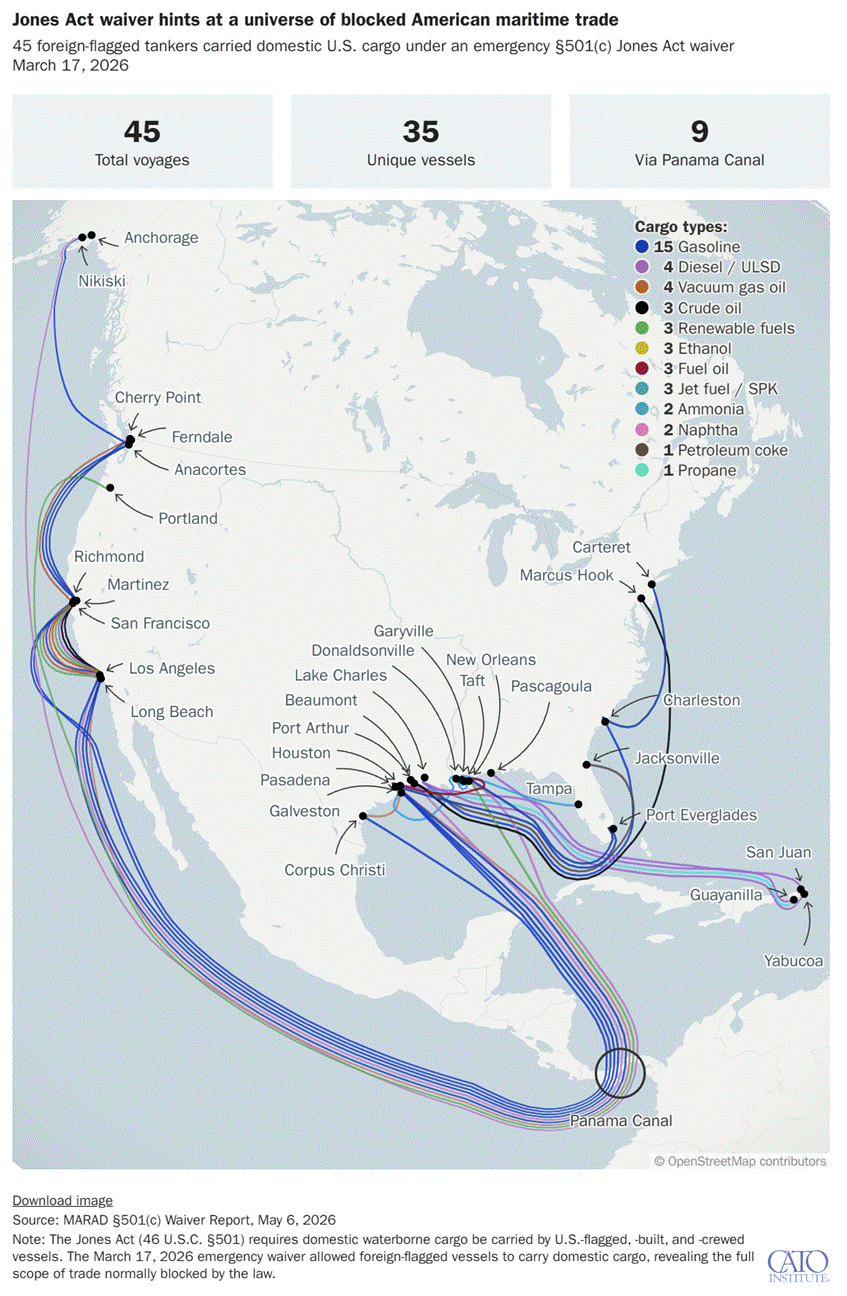
This has provided critical relief to prices at a time when inflation is once again on the upswing. The waiver is currently set to expire on August 16th, but it’s not out of the question that it gets extended again, especially with midterm elections just a few months after that.
Regarding full repeal, don’t get your hopes up. The Jones Act lobby, comprised of maritime unions and domestic shipbuilders, is a tough one to beat.
What’s Next?
Boy, do we have some Policy Gripes in the pipeline. For the time being, we’ll try to get a construction post out later this week before Friday’s Week in Review. Week in Review is only for paying subscribers. If that’s not you and you want it to be, just click the button below:
I agree that the Jones Act is bad policy, but this inference is sloppy.
Using a 4x increase in Gulf-to-West-Coast shipments during a temporary waiver as evidence of normal suppressed demand ignores the obvious confounder: the waiver occurred during an Iran/Hormuz-related energy shock. Given the West Coast’s exposure to imported crude and refined-product supply chains, a surge in alternate Gulf supply is exactly what one would expect in a crisis.
That does not vindicate the Jones Act. It probably condemns it more narrowly: the law makes U.S. logistics less flexible when flexibility matters most. But that is different from proving the waiver-period volume reflects ordinary demand that was sitting there all along.
As a paying subscriber, I expect better causal discipline than this.